Mesenchymal stem cells (MSCs), also referred to by the term Medicinal Signaling Cells (MSCs), can be isolated from many tissues, but for cell therapies aimed at tissue regeneration, MSC are isolated mostly from bone marrow (BMSCs) and now increasingly from adipose tissue (ASCs). MSCs are cells with unique abilities to self-renew, multiply and transform into many types of specialized cells, in laboratory such as cells of bone, fat, cartilage, muscle, tendon, joint etc. MSCs also influence the immune system by secreting compounds that promote immune responses directed, for example, against bacteria or pathogenic parasites. All these features make MSCs to find broad applications in regenerative medicine, transplantation and in the treatment of many diseases.
MSC in therapy of bone diseases
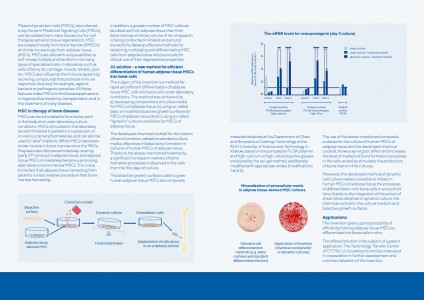 MSCs can be stimulated to form bone, both in the body and under laboratory culture conditions. MSCs stimulated in the laboratory are administered to patients in suspension or on various carriers/biomaterials, and can also be used to ‟“‟alive” implants. While MSCs have been known to exist in bone marrow since the 1960s, they were also discovered relatively recently (early 21st century) in adipose tissue, and adipose tissue MSCs immediately became a promising alternative to bone marrow MSCs. This is due to the fact that adipose tissue harvesting from patients is a less invasive procedure than bone marrow harvesting. In addition, a greater number of MSC cells can be obtained from adipose tissue than from bone marrow of similar volume. A lot of research is being conducted in Poland and around the world to develop effective methods for obtaining, multiplying and differentiating MSC cells from adipose tissue into bone cells for clinical use of their regenerative properties.
JU solution – a new method for efficient differentiation of human adipose tissue MSCs into bone cells
The subject of the invention is a method for rapid and efficient differentiation of adipose tissue MSC cells into bone cells under laboratory conditions. The method was achieved by a) developing compositions of culture media for MSCs of adipose tissue, b) using so-called basic or modified bioactive growth surfaces for MSCs of adipose tissue and c) using so-called “dynamic” culture conditions for MSCs of adipose tissue. The developed chemical cocktail for stimulation of bone formation, added to standard culture media, effectively initiates bone formation in cultures of human MSCs of adipose tissue. Thanks to the above-mentioned treatments, a significant increase in markers of bone formation processes is observed in the cells from the first days of culture. The bioactive growth surfaces used to grow human adipose tissue MSCs are composite materials obtained at the Department of Glass and Amorphous Coatings Technology at the AGH University of Science and Technology in Krakow, based on biocompatible PLGA polymer and high-calcium or high-silica bioactive glasses produced by the sol-gel method, additionally modified with appropriate oxides (modifications 1 and 2). The use of the above-mentioned composite surfaces for the culture of human MSCs of adipose tissue and the developed chemical cocktail, shows a synergistic effect and increases the level of markers of bone formation processes in the cells, as well as stimulates the production of bone matrix in the cultures. Moreover, the developed method of dynamic cell culture makes it possible to initiate in human MSCs of adipose tissue the processes of differentiation into bone cells in a very short time, thanks to the integration of the action of shear stress obtained in dynamic culture, the chemical cocktail in the culture medium and bioactive growth surfaces.
Applications:
The invention opens up the possibility of efficiently homing adipose tissue MSCs to differentiate into bone cells in vitro. The offered solution is the subject of a patent application. The Technology Transfer Center of CITTRU UJ is looking for entities interested in cooperation in further development and commercialization of the invention.
information / broker of Jagiellonian University